
 English
 русский
 Español
 عربى
عربى
What Did ASTRACE Unveil at the 2026 LANCI Smart Glass Forum?
Content
- 1 Inside the 2026 LANCI Automotive Smart Glass Forum
- 2 A Keynote on Solving the Transparency-Privacy Trade-off
- 3 From Functional Component to Experience Interface
- 4 The Technology Behind the Framework
- 5 Live Demonstrations on the Exhibition Floor
- 6 A Concept Vehicle Built Around Full-Vehicle Glazing
- 7 Why This Fits Our Broader Approach to Film Technology
Inside the 2026 LANCI Automotive Smart Glass Forum
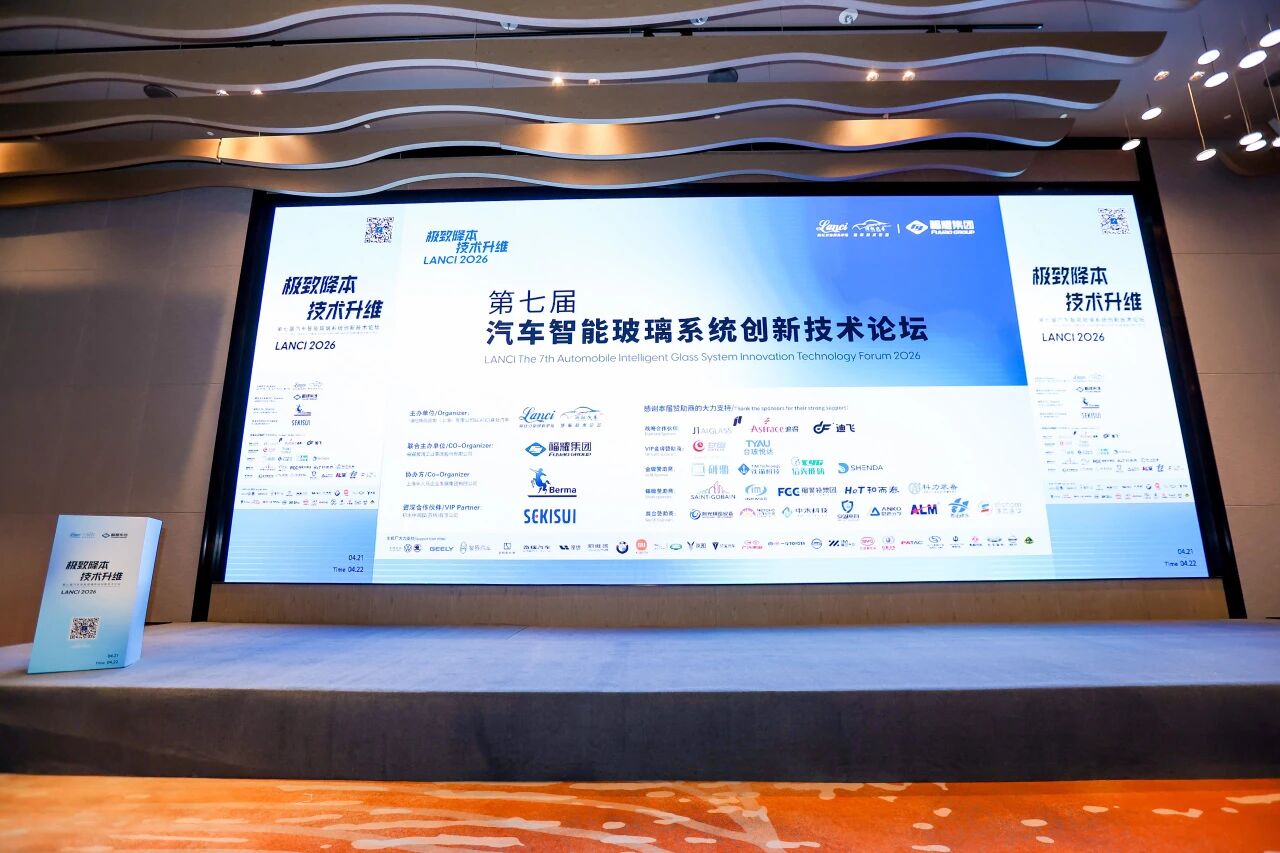
Founded in 2003, ASTRACE was among the strategic partners at the 7th LANCI Automotive Smart Glass System Innovation Technology Forum, held April 21 and 22 at the Hyatt Regency in Shanghai Songjiang. The two-day event brought together OEMs, glass suppliers, and research institutes around a single theme: driving down cost while pushing the technology forward, in order to reshape what automotive glass can be.
The agenda was organized around four core tracks — technology integration and systemic innovation, ecosystem collaboration, process innovation, and integrated lightweight solutions — reflecting how central glass has become to the future mobility experience. Representatives from OEMs including SAIC Volkswagen, BMW, Geely, Li Auto, and Xiaomi attended alongside glass manufacturers and industry researchers, making the forum one of the more closely watched gatherings in the smart cabin space this year.
A Keynote on Solving the Transparency-Privacy Trade-off
In the session dedicated to ecosystem collaboration and process innovation, a keynote titled "Transparent, Private, and Beautiful — How Smart Dimming and Display Technology Meets the Demands of Next-Generation Cabin Glass" walked the audience through how the role of cabin glass is being redefined as vehicles become more intelligent.
The talk was structured around three angles — how the industry itself is evolving, what users are now expecting from their cabin experience, and which technology paths can actually deliver on both. As a company that has spent more than two decades specializing in glass performance enhancement and surface performance optimization, we approached the session less as a product showcase and more as a structured view of where next-generation cabin glass is headed.
From Functional Component to Experience Interface
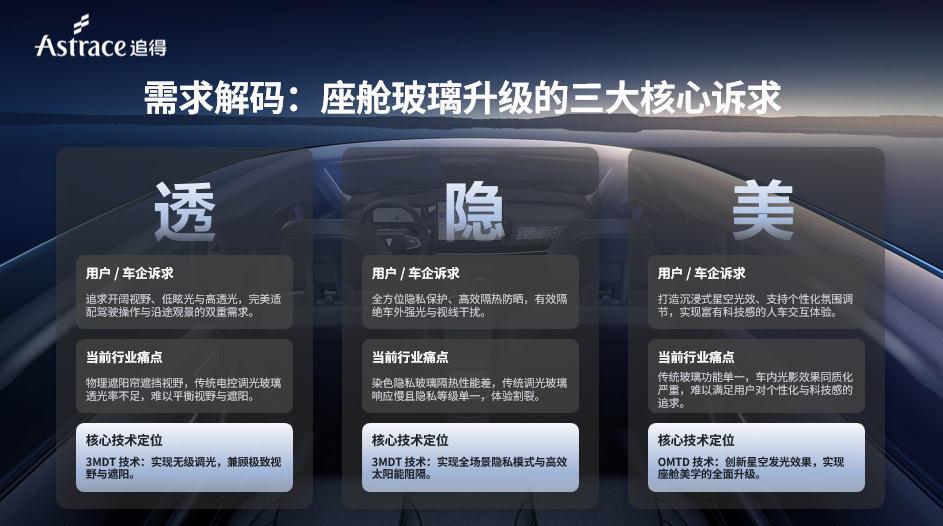
A central point of the keynote was that cabin glass is shifting from a functional component to an experience interface. Glass is moving from being a simple "space boundary" toward becoming a "smart interaction core," increasingly responsible for regulating the light environment and supporting how occupants interact with the vehicle. At the same time, user expectations have moved past basic sun and heat protection toward a combined pursuit of transparency, privacy, and interior atmosphere.
Based on that shift, the forum introduced a "Transparent, Private, and Beautiful" framework, structured around three goals:
- Transparent: delivering a clear field of view and effective sun protection across a wide range of driving scenarios
- Private: providing consistent privacy protection across all lighting conditions, together with efficient solar heat blocking
- Beautiful: extending the cabin's light, color, and emotional atmosphere through the glass itself
The Technology Behind the Framework
The transparency and privacy challenge breaks down into two direct questions: is the clear state actually clear, and is the private state actually private? Conventional dimming glass typically reaches only around 10% light transmittance at its clearest, which can create safety concerns in low-light conditions such as underground parking or rainy nights. On the privacy side, most existing technologies rely on scattering or absorption alone, which leaves them vulnerable to close-range viewing, reduces visual comfort, and often depends on the cabin lights being switched off to work at all.
The answer presented at the forum is a composite model combining scattering, absorption, and zone-level control, built on proprietary 3MDT patented technology and delivered in film form as 3MDT-FLC. The film achieves millisecond-level switching response with zero color deviation and haze as low as 1%, while maintaining genuine privacy protection across all lighting scenarios rather than only when the cabin is dark.
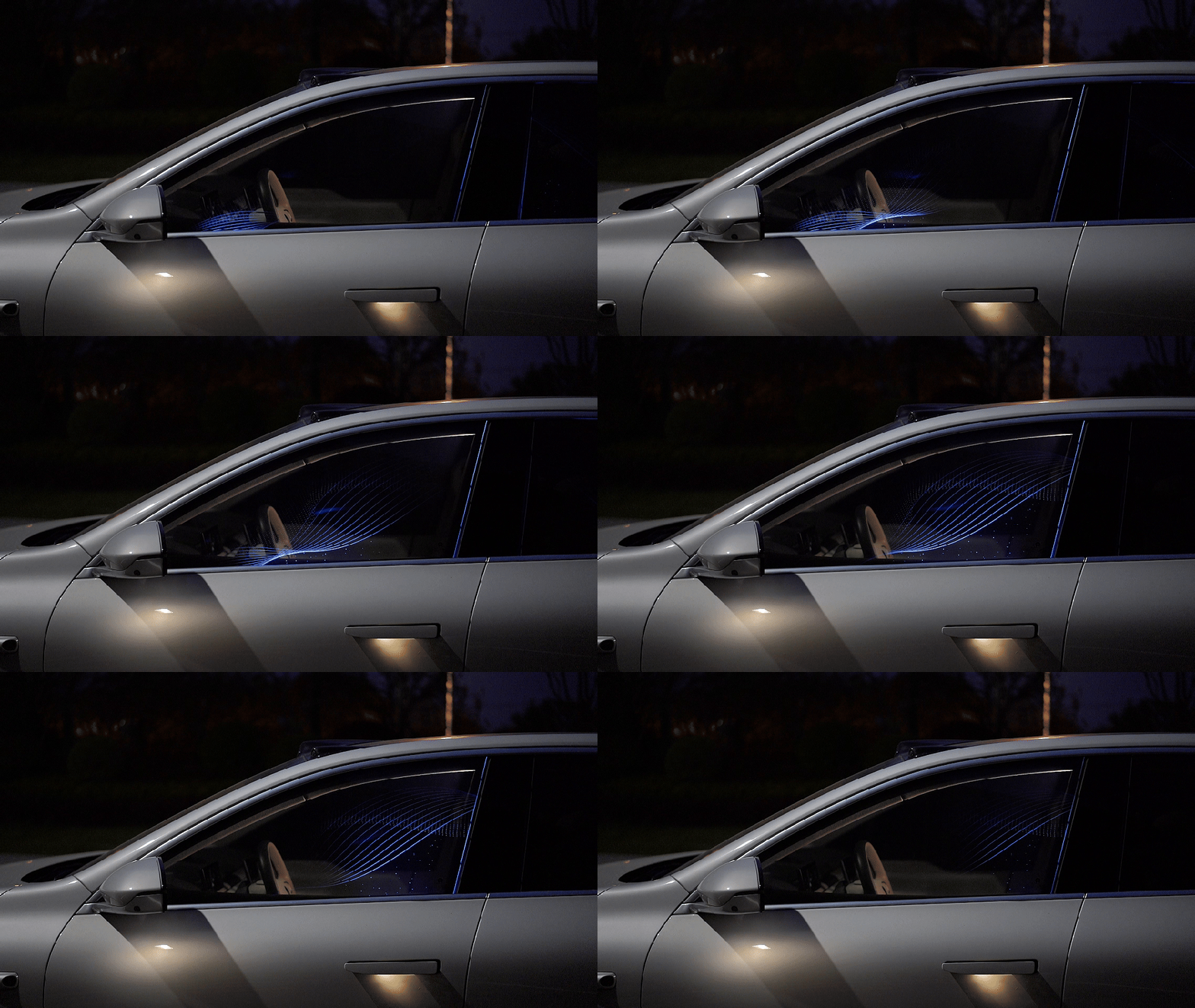
To address the "Beautiful" dimension, the OMTD electro-optic display film extends the visual expression capability of the glass itself. Key attributes shared during the session included soft crystal-blue coloring that stays fully transparent and invisible by day while creating a relaxed, tech-forward atmosphere at night, precise control over crystal depth for dynamic light mapping within a roughly 100-micron space, and imaging resolution up to 600 dpi with 2.5D visual effects and hundreds of customizable dynamic lighting themes.
Live Demonstrations on the Exhibition Floor
Beyond the keynote, the forum's exhibition floor gave attendees a chance to see the technology firsthand. Guests exploring next-generation cabin concepts stopped by to discuss the practical side of the "Transparent, Private, and Beautiful" approach, walking through how the 3MDT dimming film and OMTD display film work together in real glazing applications.
Live demonstrations let visitors see the dimming-to-display transition directly on window samples, switching between transparent and private states under different lighting conditions while layered light effects played across the surface. Attendees consistently commented on how smooth the transitions felt and how expressive the display output was, reinforcing the idea that cabin glass is shifting from basic function toward genuine experience design.
A Concept Vehicle Built Around Full-Vehicle Glazing
One of the most closely watched elements on display was a concept vehicle demonstrating the OMTD display film applied across the entire glazing surface — not as an isolated feature on one panel, but as a coordinated system spanning the panoramic roof and side windows together.
The demonstration was built around three capabilities:
- Consistent clarity across the whole vehicle when the system is switched off, without compromising driver visibility
- Coordinated color and light changes across every panel, creating one continuous, immersive cabin atmosphere
- Extended interaction possibilities enabled by display capability across the full glazing surface
Visitors from OEMs, glass suppliers, and research institutes showed particular interest in this "whole-vehicle photoelectric glazing" approach, with many conversations at the booth focused specifically on production feasibility and the path to mass-market application.
Why This Fits Our Broader Approach to Film Technology
The 2026 LANCI forum made clear that cabin glass is being treated less as a passive component and more as a strategic design surface across the industry. That mirrors how we think about film technology at ASTRACE: rather than treating dimming, privacy, and display as separate problems, we cover the full value chain — R&D, customization, branding, and full-service support — so that glass performance enhancement and surface performance optimization can be delivered as one coherent system rather than a patchwork of add-ons.
Looking ahead, we plan to keep deepening this technology system in collaboration with OEMs and supply chain partners. As one of China's established car film manufacturers and a supplier of smart glass film for automotive customization, our goal is to turn every glass panel in the vehicle into a surface capable of carrying both experience and expression.

-

Building 1, Building 3, No.68 Kangyuan Road, Qingpu District, Shanghai, China
-

-
-

+86-17621250420
Copyright © Shanghai Astrace New Material Technology Co., Ltd. All Rights Reserved. Car Modification Smart Glass Film Supplier
